

Walk into a Harley-Davidson dealership with a cash offer and a motorcycle that is more than a century old, and you find out quickly how much the people behind the counter know. One owner did exactly that, carrying a handwritten sign that promised 1,000 dollars to anyone who could start his 1913 Harley-Davidson.
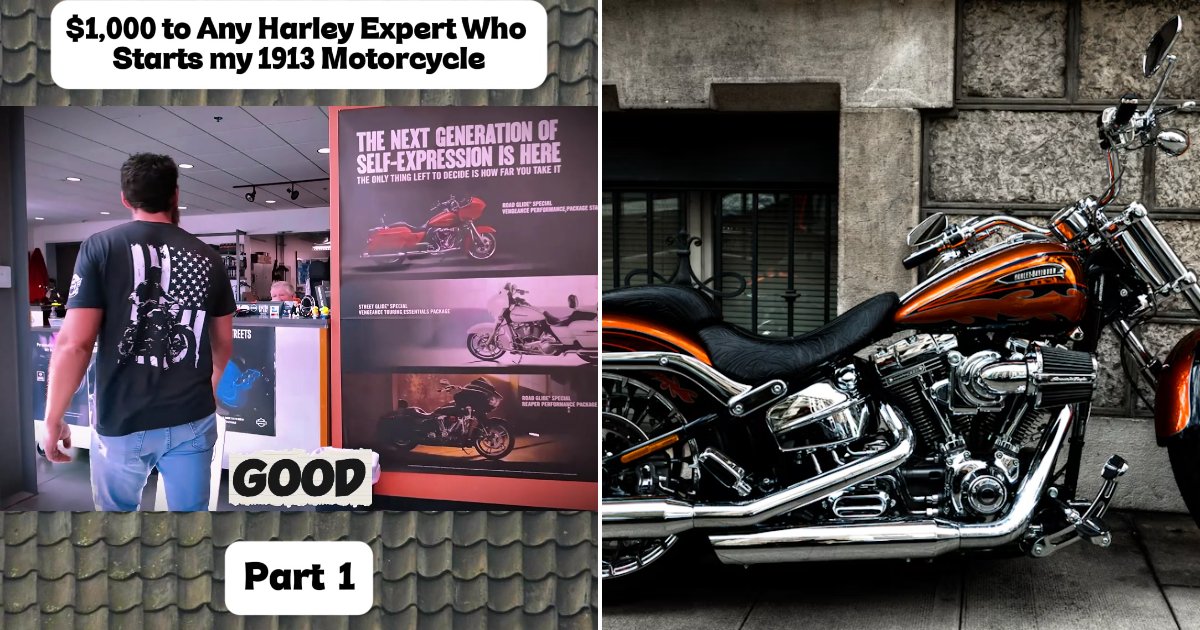
The challenge was shared by @dianabrady19965 as the first part of a series.
@dianabrady19965
The offer at the service counter
The owner greets an employee at the customer service counter and asks whether any of the technicians, or even the salesmen, can start his Harley. He says he has a thousand dollars for whoever manages it. When the employee asks the year, he answers 1913, adds that it runs the way it should, and points out that he even made the sign. The employee says there are two guys in the back, and soon they are all heading outside to look.
A board track racer in the parking lot
Out in the sunny parking lot, two dealership workers gather around the motorcycle, which sits on a display stand. It is a board track racer, a type of early racing machine, and the owner sets a timer on his phone. One worker is skeptical about the whole thing, saying honestly that he does not see how anyone could do it, though he admits he has been wrong before. The owner keeps the rules simple: he will not demonstrate how it starts, because that is part of the challenge.
At one point someone points out oil dripping. The owner laughs it off and says that is what the machine is supposed to do. Then the clock starts and a worker steps up with two minutes to work.
Two minutes with no pedals, no clutch and no brakes
The worker goes over the engine, levers and pedals. He asks about the pedals and learns that they are locked in place, because on a board track racer you do not pedal it to start it. He identifies a part as an oil pump, not a fuel pump, and he finds the choke. He says the lack of a clutch and brakes really throws him off, and when the owner calls out that 20 seconds remain, he is still working through what each part does.
Asked when the motorcycle last ran, the owner says it fired up a couple of weeks earlier and that it is fairly easy if you know how. Later the owner offers the challenge to the second worker, who says he is not going to try, and the first worker admits that he has been sitting there failing. This is only the first part of the story, and the outcome of the full challenge is not given here.
What this shows about early motorcycles
Modern riders are used to a button, a clutch lever and a front brake. A machine from 1913 asks for something completely different, and the dealership staff clearly had not seen one set up like this before. The owner says very few people have seen a bike start this way.
- Early motorcycles can differ widely from modern ones in controls, so study the machine before you touch it.
- Never assume a part does what you think. The worker had to work out the oil pump, the choke and the timing cap on the fly.
- If you are curious about vintage machines, bring questions to owners who can explain the starting procedure.
- Leaking oil on a very old engine is not always a sign of a problem, according to this owner.
What board track racing was
Board track racing, sometimes called motordrome racing, was a popular form of motorcycle competition in the United States in the 1910s and early 1920s. Races were run on steeply banked oval tracks built from wooden planks, and the machines were stripped to the essentials to make them light and fast. Many of them had no brakes, because racers were meant to hold a steady speed on the oval and slow down by easing off. Harley-Davidson, which was founded in 1903, was one of several American makers that built racing machines in this period. That history explains why a modern technician can look at a racer like this one and see controls that make no sense at first glance.
Why a century old engine starts differently
Every engine needs the same basic ingredients: fuel and air, a spark and compression. What changed over the last hundred years is how a rider delivers them. On many early machines the rider managed more by hand. There might be an air or choke lever, a lever to adjust the spark timing, a manual oil pump instead of an automatic one, and no electric starter at all. Getting the engine rolling often means moving the machine, using a stand or a push, rather than pressing a button. Each model is different, so the starting routine is something to learn from the owner or a period manual instead of guessing.
If you ever meet a vintage machine
- Ask before you touch. Valuable antiques can be damaged by a wrong move, and a stranger’s curiosity can cost the owner a repair.
- Keep your distance from the chain, belt and rear wheel.
- Remember that fuel and hot parts are close together on a bike with no body panels. Stay clear of ignition sources.
- Take photos of the controls and ask what each does. Owners usually enjoy explaining.
Credit for the original post goes to @dianabrady19965 on TikTok.