

Modern cars know a lot about the people who drive them, and one shop owner thinks the industry wants to know even more. Sherwood of Royalty Auto Service leaned against his tool chest and laid out a story about a Ford owner who tried to opt out of vehicle tracking, only to find that her car had other plans while it sat parked in the garage overnight.
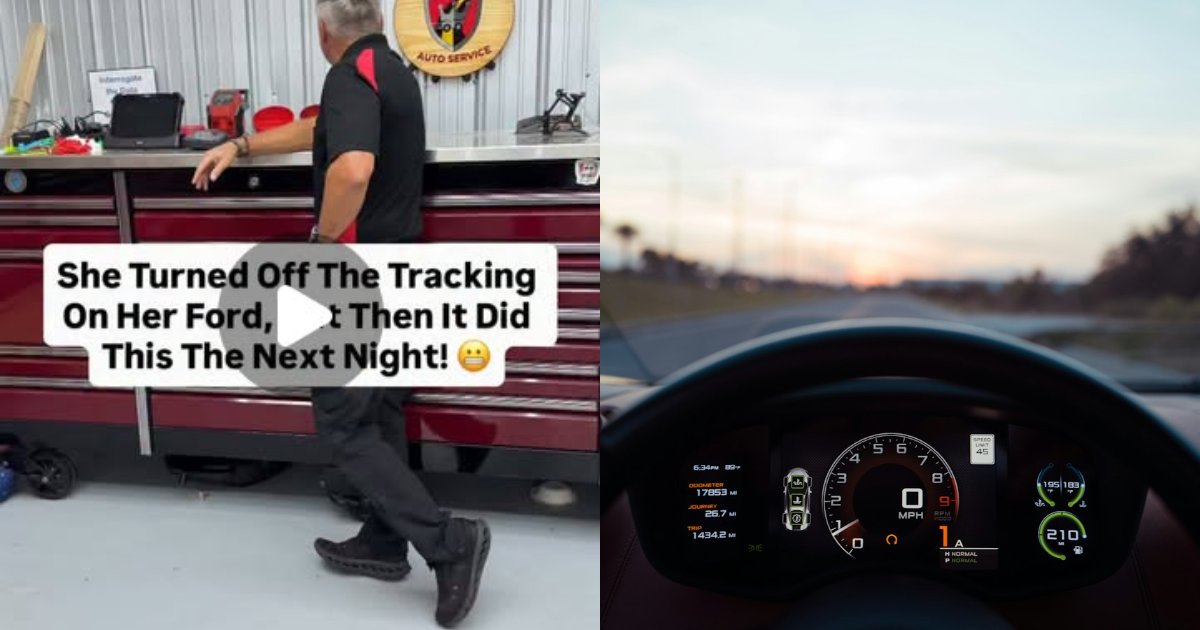
The conversation comes from @theroyaltyautoservice, where Sherwood sits down with his son, who asks the questions, inside the shop.
Cars that behave a lot like social platforms
The talk starts with a common worry: people are concerned that their vehicles are tracking every move they make. Sherwood does not sugarcoat it. In his view, newer cars work a lot like a social network, collecting as much as they can about the person behind the wheel, including where you go, how long you stay, how fast you drive and how hard you brake.
He says manufacturers are making it hard to avoid, and his son pushes the conversation toward a specific example that Sherwood had recently come across.
The Ford owner who switched everything off
Sherwood describes a woman who owned a newer Ford and had turned off all of the tracking and data sharing features she could find. She also tried to turn off the over the air updates, which let a manufacturer push new software to a parked car at night without the owner doing anything. According to Sherwood, the car would not let her opt out of those updates.
His son pointed out that computers have always updated themselves. Sherwood’s answer was that a computer at least asks first. The car, he said, just does it.
What happened the next morning
As Sherwood tells it, the woman heard clicking in the garage during the night, which he guessed was the update being installed. When she started the car the next morning, a message appeared on the screen telling her she had now opted in to the tracking and information sharing she had previously switched off.
The part that bothered him most was how short the notice was. He says it only stayed on the screen for a few seconds, and that a driver who climbed in and looked at a phone instead would never have seen it. She caught it, went back into the settings and turned everything off again.
It is worth noting that Sherwood is relaying this account secondhand, and he says himself that he could not find the original again. He also makes clear he is not claiming Ford sells anyone’s information.
Where does the information go?
Sherwood’s bigger worry is what happens to the data. He points out that when a service is free, the user is often the product, and that a lot of companies have been shown to sell personal information. His concern is that driving data could end up with insurance companies.
He compares it to the plug in devices some insurers offer that connect to a car’s diagnostic port and track how it is driven in exchange for a discount. His problem is that the device cannot tell who is driving, and it cannot tell why. A hard stop because someone ran into the road looks the same as careless braking, and instead of a discount a driver could end up paying more. Sherwood says that kind of arrangement is sketchy to him and not something he wants.
Takeaways for owners
These are general habits that follow from the story, not instructions from the manufacturer.
- Look at the screen when you start a car that has just been serviced or may have received an update, since notices can disappear quickly.
- Recheck your privacy and data sharing settings now and then, especially after a software update.
- Read the terms of any insurance program that monitors your driving before you sign up, and ask who else may drive the car.
- Ask your dealer or the owner’s manual what data your vehicle collects and how to limit it.
How an over the air update works
Over the air updates are not unique to one brand. Many newer vehicles have a cellular connection and several computer modules, and a manufacturer can send new software to some of them without a trip to the dealership. Depending on the vehicle, an update may install while the car is parked, and some require the owner to approve it first. Which category your car falls into depends on the make, the model year and your settings, so the owner’s manual or the dealer is the place to confirm it.
Questions to ask before joining a driving monitor
The plug in devices Sherwood mentions use the on board diagnostic port, a standard connector under the dashboard of cars sold in the United States since the mid 1990s. Some insurers also offer phone based programs that need no device. If you are weighing one, a few questions are worth asking first:
- What exactly is measured: braking, speed, time of day, mileage, phone use?
- Can the program raise your rate, or can it only give a discount?
- How long is the information kept, and can it be shared?
- What happens when someone else, such as a teenager, drives the car?
- Can you leave later, and is your data deleted when you do?
One more caution: turning off connected services can also switch off helpful ones, such as emergency calling, and removing fuses or modules can affect safety systems and warranty coverage. Ask a qualified technician or the dealer before touching hardware.
Credit for the original post goes to @theroyaltyautoservice on Instagram.