

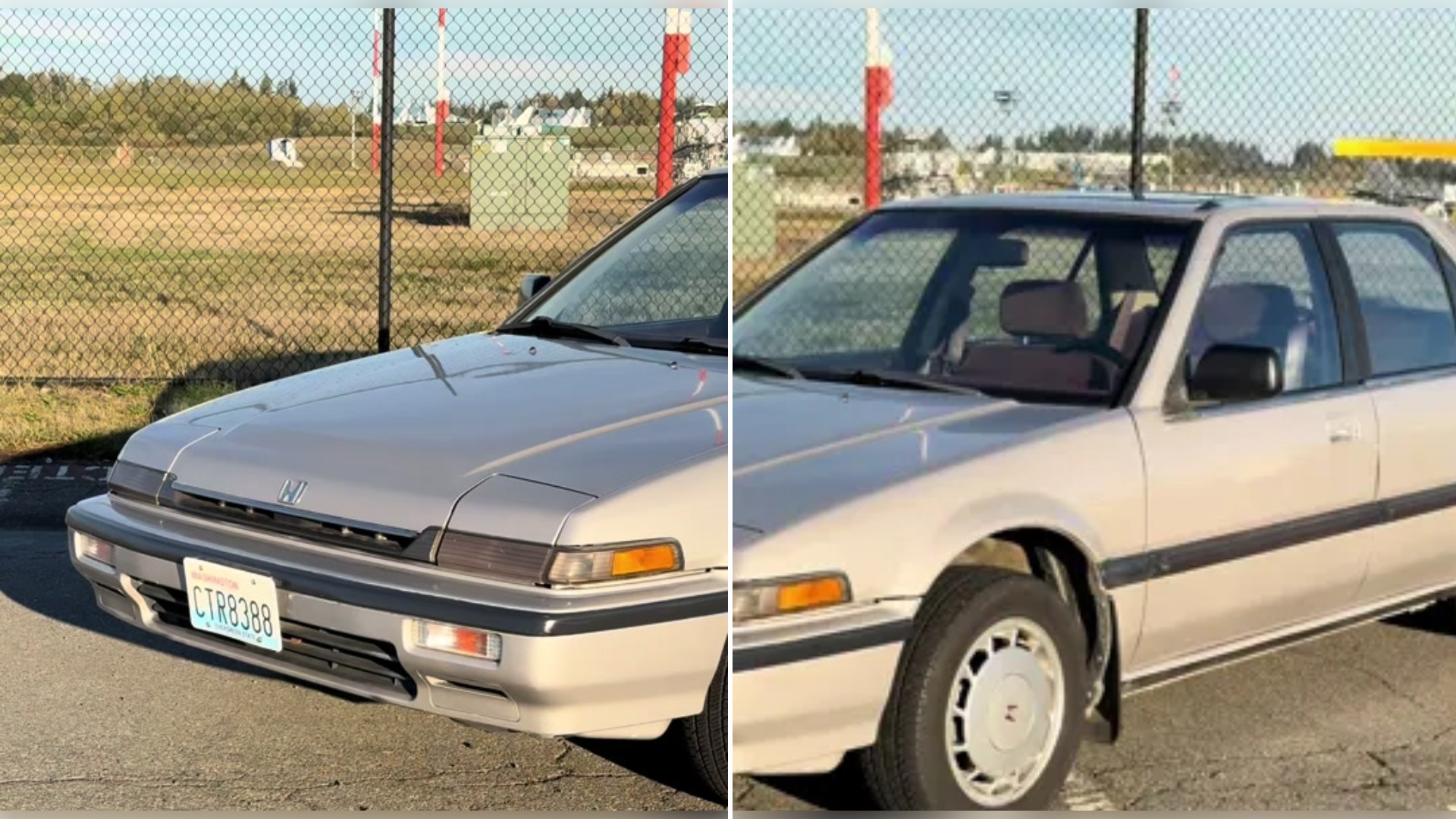
A driver with a 1988 Honda Accord LXi needs only 15 seconds to make his argument for old cars, and he makes almost all of it with his hands. In a short clip, @corbetting walks through the small physical rituals of starting and driving the sedan, then leaves viewers with a question in the caption: “Is this the best built Honda ever produced?”
The video opens on the car parked beside a chain link fence, its low nose pointed at the camera and its headlights tucked away under flush covers. The paint is a pale metallic beige and the body looks straight and complete. Text on the screen stays up for the whole clip: “37 Years Young. Still more fun than your car.”
“In a world of modern machines, there’s beauty in the classics,” a voiceover says as the camera moves inside. The first stop is the driver’s seat, which is upholstered in thick, ribbed velour in a deep burgundy. He presses a hand into the cushion to show how soft it is. The fabric looks clean and unworn, with no splits or sagging.
Next comes the key. It is a plain cut metal key with no buttons on it, and he slides it into the ignition on the steering column and turns it. Then he twists the headlight switch on the end of the stalk. Outside, the cover on the nose lifts and a square headlight rises out of the hood line, already glowing. “Celebrate the honesty of old cars,” the voiceover says.
The stereo gets the same treatment. He pushes a cassette into the slot of the dashboard radio, where the display glows in blue green digits, and presses a button with one finger. The last shots are from the driver’s seat on the move. His right hand rests on a manual shifter, a burgundy mat covers the top of the dashboard, the Honda badge sits in the middle of the steering wheel, and low sun pours through the windshield as the road opens up ahead. The voiceover closes with three words: “Be the driver.”
The caption fills in the rest. He writes that the “MSRP in 1988 was $13,910 for this top trim LXi,” and tags the post with words like Analog, 80s and GenX. He does not give the mileage, the maintenance history or how long the car has been with him. The pitch is not about numbers. It is about a car where every function has its own switch and every switch does one thing.
That pitch lands with a lot of drivers, and it is worth knowing what comes with it before shopping for a car this old. The first rule is that age matters more than mileage. Rubber parts harden and crack with time whether a car is driven or not, so belts, coolant hoses, fuel lines, vacuum lines and suspension bushings all deserve a close look on any car from the 1980s, even one with a low odometer reading.
Ask for proof of the last timing belt replacement. Engines of this era commonly use a rubber timing belt that has to be changed on a schedule of both miles and years. If the seller has no receipt, plan to do the job right away. A belt that snaps will leave you stranded, and on many engines it can cause serious internal damage.
Look hard for rust. Hondas of this period are known to rust around the rear wheel arches, and the rocker panels, the floor and the trunk floor under the mat are worth checking too. Fresh paint on the lower body of an old car is a reason to bring a magnet and ask questions. Structural rust is the repair that most often costs more than the car is worth.
The charming features in this video are also the ones to test. Pop up headlights depend on motors and linkages, so run them up and down several times and make sure both sides rise evenly and stay up. Ask the seller to show you how to raise them by hand if a motor quits. Try a cassette you do not care about in the tape deck, because old drive belts stretch and a tired deck can chew a tape. Run every window, the fan on each speed and the air conditioning. Cars of this age were built to use R12 refrigerant, which is no longer produced, so ask whether the system has been converted.
Be realistic about safety. Cars from the 1980s generally lack the airbags, antilock brakes and stability control that modern drivers take for granted. Leave more following distance, check that the seat belts latch and retract properly, and read the date code on the tires instead of judging them by tread alone. Old tires with plenty of tread can still be unsafe.
Parts are a mixed picture. Routine service items for an old Accord are usually still easy to buy, but interior trim, seat fabric and exterior pieces are much harder to find. That makes a clean, complete cabin like the one in this clip worth paying extra for. Before you hand over money, have a mechanic who knows older Hondas put the car on a lift, and ask your insurer about an agreed value policy if the car will not be your daily transportation.
None of that takes away from what the clip shows. A key that turns, a headlight that rises, a tape that clicks into place and a shifter under the right hand are the whole reason he calls a 37 year old sedan more fun than your car.
More from Steel Horse Rides
- Creator Films a Vintage 1984 Mercedes Convertible, Then Says It Still Looks Almost Brand New Forty-Two Years After It First Rolled Off the Line
- 9 Cars We Took for Granted That Have Become Surprisingly Desirable
- Honda Builder With More Than 15 Years of Experience Launches His Car Channel by Showing the Engine Bay He Stripped and Repainted Before Taking Three Passengers for a Ride