

For more than thirty years, a Texas man held on to two old farm gas pumps that came off his granddaddy’s land. He never thought of them as worth much money. Then he noticed what pumps in that kind of shape were going for, and the number surprised him: eight or nine hundred dollars.
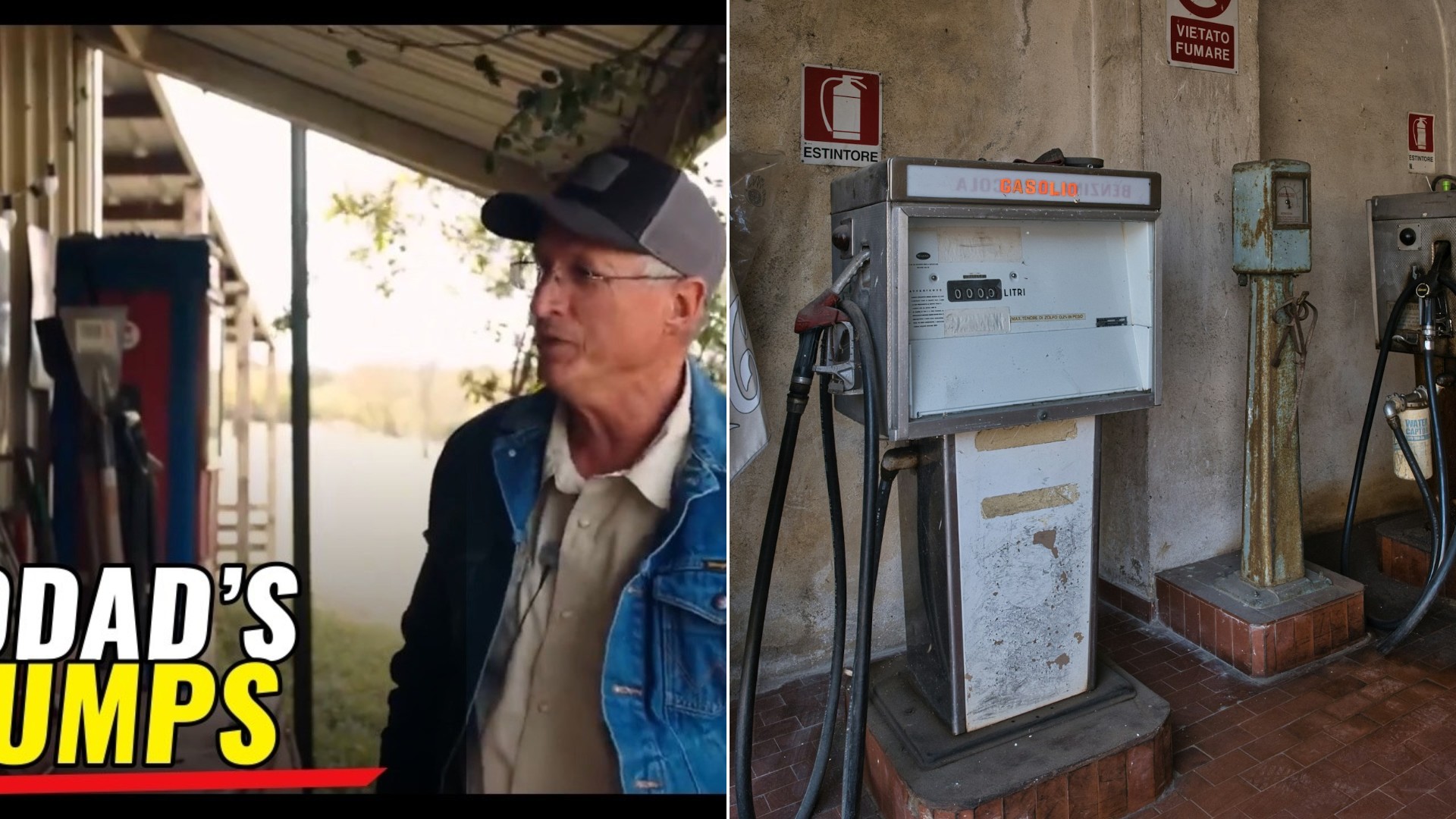
The man, who goes by Scotty, shared his collection of gas pumps and porcelain signs in a tour posted by @289filmco (289 Film Co.). He lives in Honey Grove, Texas, and he is quick to say his collection is nothing real special, but it is special to him. Almost every piece has a story, and many of them start with someone handing him something and saying they wanted it to be taken care of.
Riding Around With Granddaddy
Scotty says he got into collecting signs years ago. As a little kid he rode around with his granddaddy to the full service gas stations and saw the porcelain Texaco and Exxon signs, and he always thought they were neat. Collecting them takes him back to something he feels we have lost. He remembers Nunley’s Texaco, right off the square in Honey Grove: a man comes out, cleans your windows, puts your gas in and fixes your flats. It was a real good memory.
A lot of his signs came from around Honey Grove and were given to him by good friends. The Texaco sign has the sweetest story. When he was about fifteen, he painted houses with a man named Billy. The other day, Billy had a Texaco pump in his backyard and wanted a small Texaco sign that Scotty owned. Scotty said sure and took it over. Billy then said he had something to give him in return, walked him into a little shop, pointed at the wall, and gave him another sign. Scotty said no, you cannot do that. Billy did it anyway. He wanted to make sure it was taken care of.
The Pumps From Granddaddy’s Land
The pumps are the heart of the collection. Scotty’s granddaddy was a local cotton farmer in Honey Grove, and the Mobilgas and Texaco pumps stood on his land. Back then, if you bought your fuel from Texaco, they furnished you a pump so you could fill your tractor. Scotty thinks one of them is a 1948 pump, made at Southwest Pump in Bonham, Texas, and he thinks the price on it was 46 cents a gallon.
An old Ethyl pump also came off his granddaddy’s place. The Mobilgas plate on it was gone, so he found another one and put it in its place. It is special to him because it was his granddaddy’s, and his uncle used it too when he went into farming after his granddaddy quit.
Here is where the surprise comes in. Scotty says he had the pumps for 30 or 35 years, and he would not say they were valued at all. These days, he has seen them going for eight or nine hundred dollars in that kind of shape.
A Feed Store Sign And A Free Mower
The Browns Feed sign came from a school friend’s family. Tracy Brown’s granddaddy ran a feed store in Honey Grove for years before it went out of business. Scotty mowed their place and would not charge them. One day Tracy’s daddy came out to pay him and he still would not take the money. So the man told him to go get the sign off the old feed store, because he wanted Scotty to have it. It means a lot to him.
Some of the other signs are worth real money. A big Chevron dealer sign cost him about four hundred dollars, and he says it probably was not worth two dollars when he bought it years back. A friend named Mike Blair found another sign under a Victorian house while patching a hole, a sign for the oil Ford used to run in its vehicles, and Scotty figures it is a nine hundred dollar sign.
Then there is the mower. It is a Whipper Clipper, made in Bonham, Texas, sometime between the early 1950s and the middle of the 1960s. Scotty’s wife was painting for a man named Wally Black when Scotty went up to talk to her and saw a tarp in the corner. Being nosy, as he admits, he pulled it up and gasped. He had never seen one in his whole life. Wally told him he used to mow with it as a kid, because his daddy bought it brand new in Bonham. Wally made Scotty an offer: restore that mower and you can have it. So he did. It has a Clinton motor, which they do not make anymore. It is called the Common Sense mower, and it runs.
Through all of it, Scotty is humble. His signs are pretty beat up, he says, and he is not rich, but they mean a lot to him. They might not mean anything to anybody else, but he loves them.
What To Take From A Collection Like This
- Check before you toss. Old farm pumps, signs and tools can be worth hundreds, and a pump that sat on a farm for decades might be worth far more than you think. A quick look at what similar pieces sell for costs nothing.
- Do not over clean. Collectors often prefer original condition. Scotty did replace a missing Mobilgas plate, which is a reminder to know what is original and what is not, and to be open about it if you ever sell.
- Keep the story with the object. A porcelain sign from a friend’s feed store is worth more to the family than any price guide, and the story helps a future owner understand why it mattered.
- Be generous when you can. Many of Scotty’s best pieces came from kindness, a free mowing job or a favor for a friend, not a cash deal.
- Ask before you pull the tarp. Scotty found his mower because he was nosy, and he got it because he promised to restore it and keep it running.
Most of us are not going to find a treasure under a tarp, but nearly everyone has something in a garage, barn or attic that belonged to someone they loved. Scotty’s tour is a reminder to take a second look at those things, and to remember that the value you cannot put a price on is usually the one worth keeping.
More Stories You May Like
- Mechanic’s Dad Crunched Two Years Of Repair Orders And Names The Five Most Expensive Vehicles To Fix Led By Jaguar At More Than Fifteen Hundred Dollars A Visit
- Five Car Parts Every Driver Should Check At 25,000 Miles Before Small Sensor Problems Turn Into Hard Starts, Rough Idling And Stalling
- Detailer Shares How a One Man Team Can Finish a Full Car Interior in Just Two Hours, and Step One Happens Before the Vacuum Ever Comes Out