

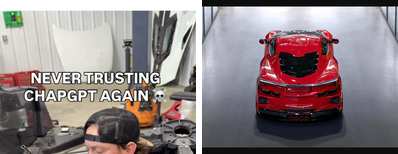
Well-known build channel @goonzquad posted a reel captioned “NEVER TRUSTING CHATGPT AGAIN,” showing a mechanic surrounded by disassembled body panels and parts after apparently tearing an entire car apart based on bad AI-generated advice. The tone is self-deprecating rather than genuinely angry, the kind of joke only someone who just spent hours undoing unnecessary work can really land.
Tucked into the same post is a tease for an upcoming video: a Corvette ZR1 rebuild, a project that’s sure to draw serious attention from the channel’s audience given the ZR1’s reputation as the flagship performance variant of the Corvette lineup.
AI chatbots have quietly become a go-to diagnostic tool for a lot of home mechanics over the past couple of years, used for everything from identifying a weird noise to walking through a torque spec. The appeal is obvious: it’s instant, free, and conversational in a way an old forum thread or a dense service manual isn’t. The catch, as plenty of garage builders are discovering, is that these tools can sound completely confident while being flatly wrong about a specific part number, a torque value, or which component is actually responsible for a given symptom.
That gap between confidence and accuracy is exactly what makes AI advice risky in a mechanical context. A chatbot doesn’t know the specific trim, model year, or prior modification history of the car in front of it unless it’s told in painstaking detail, and even then it can blend information from unrelated models or generations into a single, plausible-sounding but incorrect answer. For a seasoned builder, that might mean an afternoon wasted; for someone newer to wrenching, it can mean a damaged part or a safety-relevant mistake.
Experienced shops and build channels increasingly treat AI tools the way they’d treat a stranger’s advice on a forum: a reasonable starting point for broad troubleshooting logic, but never a substitute for a factory service manual, a verified torque spec sheet, or a second set of experienced eyes before anything gets disassembled. The difference between “this is probably your issue” and “this is definitely your issue” matters a lot more once tools are actually in hand.
As for the ZR1 itself, it’s long held the title of the most track-focused, highest-output Corvette trim available from the factory, built around a supercharged engine and chassis upgrades meant to separate it from the standard Stingray lineup. A full rebuild on a car like that tends to draw a different level of scrutiny from viewers than a routine maintenance video, since every decision, from the engine internals to the aerodynamics, carries real performance consequences.
For now, the ChatGPT mishap serves as a lighthearted reminder that even well-equipped, experienced shops aren’t immune to chasing bad information, especially when it comes wrapped in confident, easy-to-read sentences.
More from Steel Horse Rides
- Builder Turned An Ordinary Volvo Sedan Into A Full Blown Off Road Trophy Truck And The Transformation Is Almost Completely Impossible To Recognize
- Fabricator Shows Off Fresh New Upgrades On His Custom Built Armored Truck Nicknamed The Warhammer And The Engineering Inside It Is Wild To See
- Pinstriper Is Still Applying Real Gold Leaf By Hand The Exact Old School Way Traditional Craftsmen Did It Decades Ago On A Classic Car Engine Turned Panel