

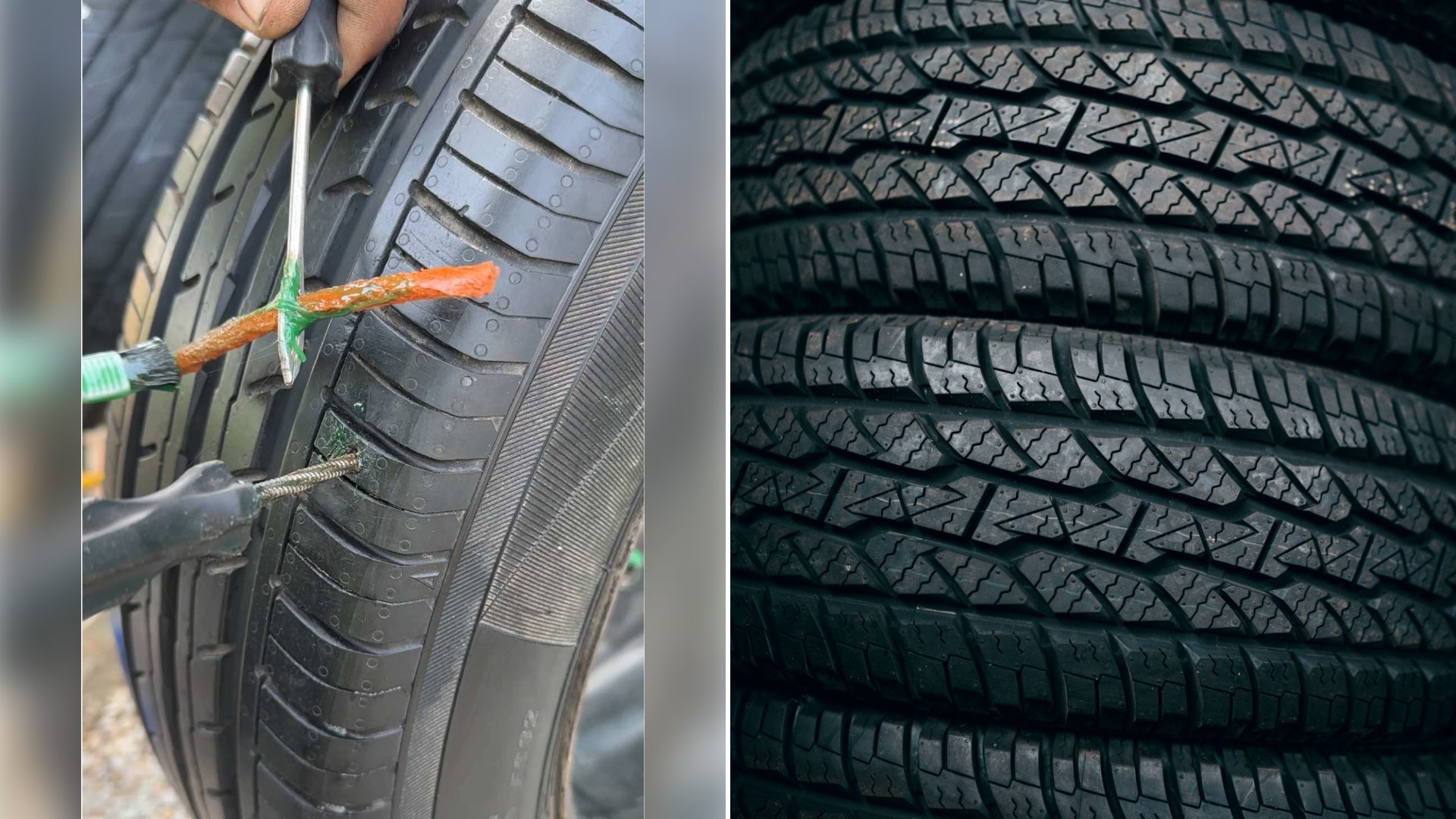
A silver screw head sits flush in the middle of a tire’s tread, sunk between two rows of blocks. Next to it, a hand holds a T handle insertion tool, its needle already threaded with an orange repair strip, poised just beside the puncture. That is the whole frame of a 62 second clip posted on September 6, 2026, by the TikTok tire repair account SK tyre mechanic (@sk.tyre.mechanic).
The caption is half English and half Hindi: “tubeless kit repair just so easy tubeless kit kaise repair karte Hain,” the second part asking how a tubeless kit repair is done. The camera holds close on the tire for the full minute.
The tire is mounted on its wheel with the screw still in place. The tool is a steel needle with an eye at the tip, loaded with a sticky orange strip. Across the clip, his thumb and the strip shift slightly against the tread, but the screw stays where it is and the shot stays tight on the same patch of rubber. In the frames reviewed, the strip is never pushed into the hole.
The screw sits in the main tread, away from the sidewall. The tread area is the only part of the tire that the procedure below allows to be repaired.
What tire makers say about plug kit repairs
The U.S. Tire Manufacturers Association, the trade body for tire makers in the United States, publishes a puncture repair procedure for passenger and light truck tires, and it is blunt about the method this clip sets up. “A plug alone is an unacceptable repair,” its tire repair basics page says. A proper repair, according to USTMA, needs a rubber stem or plug to fill the injury and a patch applied to seal the inner liner, often as a one piece plug and patch unit.
USTMA’s written procedure goes further. It says never to repair a tire from the outside in, and never to repair it while it is still on the wheel. The association says the tire must be removed from the rim and wheel assembly so it can be inspected for all possible damage, including the inner liner, which a plug pushed in from the outside cannot show.
The same USTMA procedure sets hard limits. The puncture cannot be larger than a quarter inch, or 6mm, across. Repairs are limited to the tread area, and if there is “any question” that the injury reaches the shoulder or belt edge area, USTMA says the tire “must be taken out of service.” Repairs cannot overlap, and a tire with an existing improper repair “must be scrapped.” USTMA also notes that not all tires can be repaired, and that manufacturers may restrict repairs on some tires, such as run flats.
If you find a screw in your tread
Start by looking before you pull anything. In the clip, the screw is still seated in the tread, which makes its position easy to judge: in the tread blocks, away from the edge.
Check where it is. A puncture in the main tread, like this one, is in the area USTMA allows to be considered for repair. Anything in the shoulder, the sidewall or at an angle running toward the shoulder is a replacement, not a repair, under the association’s procedure.
If you use a plug kit to get off the shoulder of a road, treat it as a way to reach a tire shop, not as the finished job. When you get there, ask for the tire to be dismounted and inspected from the inside, and ask whether they use a combination plug and patch. A shop that offers to plug it on the car without taking the tire off is doing the outside in, on the wheel repair USTMA says never to do.
Ask about the tire’s history too. A tire that already has an improper repair, or that would need a new repair overlapping an old one, is one USTMA says should be scrapped. If you drive on run flat tires, check your tire maker’s repair policy before assuming a puncture can be fixed at all.
Finally, make the check routine. USTMA recommends a monthly inspection of “proper inflation pressure, tread wear and tire damage,” including the spare, and says it matters even if your vehicle has a tire pressure monitoring system. A screw head like the one in this clip is easy to spot on a walk around the car, and much easier to deal with in a driveway than on the shoulder of a highway.
More from Steel Horse Rides
- Tire Shop Mechanic Ranks Toyo and Yokohama Above Michelin, Drops Bridgestone to C Tier Because He Says Even New Ones Won’t Balance, and Warns Off Three Budget Brands
- Roadside Assistance Worker Says He Saw a Stranger’s Tire Smoking and Followed Her to the Shoulder, Fits Her Flat Spare, Calls It Free Out of Kindness and Gives In Only When She Insists
- Bronco Driver in Chicago Finds a Red Slingback She Says Is Valentino Stuck in Her Rear Tire at the Curb, Then Films a Road Service Worker Swapping the Wheel With the Shoe Still in It